
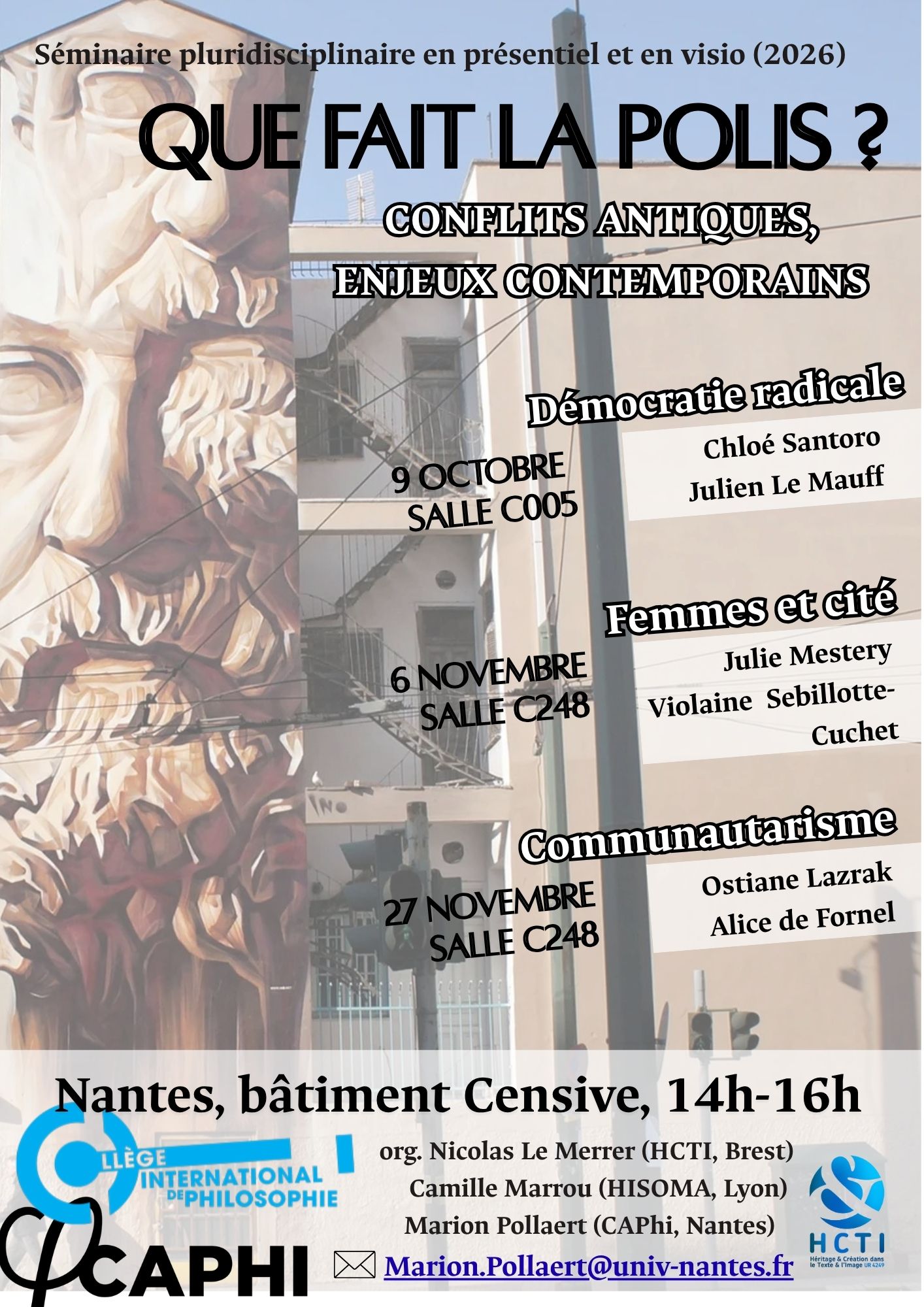
07 Sep Séminaire “Que fait la polis ? Conflits antiques, enjeux contemporains”
Le premier cycle, du séminaire “Que fait la polis ?” s’ouvrira le 9 octobre 2026 à l’université de Nantes (bâtiment Censive C2005, 14h-16h). Cette première séance réunira Chloé Santoro et Julien Le Mauff autour du thème “démocratie radicale”.
Ce séminaire multisite se déroulera à l’année entre les universités de Nantes et de Brest, et chaque séance aura lieu à la fois en présentiel et en visioconférence (via le lien suivant : https://u-visio.univ-nantes.fr/rooms/hyy-hni-v0b-hyw/join). Il est coporté par le CAPhi (UR7463), HCTI (UR4249) et le Collège International de Philosophie (CIPh).
Au premier semestre de l’année 2026-2027 auront lieu les séances suivantes (https://www.caphi-philo.fr/seminaire-que-fait-la-polis-conflit-antiques-enjeux-contemporains/), qui se déroulent toutes à l’université de Nantes :
- vendredi 9 octobre 2026, Chloé Santoro (Paris-Est Créteil – LIPHA) et Julien le Mauff (UCO – Ceraps) : “Démocratie radicale”.
Bâtiment Censive C005, 14h-16h
- vendredi 6 novembre 2026, Julie Mestery (Paris Nanterre – IREPH) et Violaine Sebillotte-Cuchet (Paris 1 – ANHIMA) : “Femmes et cité”.
Bâtiment Censive C248, 14h-16h
- vendredi 27 novembre 2026, Ostiane Lazrak (Caen – Identité et subjectivité) et Alice de Fornel (Paris 1 – Sphere) : “Communautarisme”.
Bâtiment Censive C248, 14h-16h
Le séminaire “Que fait la polis ?” se donne pour but d’explorer différents aspects de la crise démocratique contemporaine, à la lumière des débats intellectuels, des tensions sociales et des conflits pratiques auxquels ont donné lieu les expériences politiques de l’antiquité – au sein de la démocratie athénienne, mais aussi au-delà. Nous assumons que l’historien·ne ne peut manquer de poser, dans son rapport au passé, des questions du présent, revendiquant ainsi « un usage contrôlé de l’anachronisme », selon l’expression de Nicole Loraux. Ces travaux visent à articuler les exigences méthodologiques et la force critique d’une démarche historique rigoureuse à l’objectif de comprendre les références à l’Antiquité dans le champ social et politique contemporain, et d’interroger la fécondité et les limites de certaines analogies historiques, en contexte théorique et/ou militant.
Trois volets seront abordés au cours de l’année 2026-2027 :
1. Échos du monde social : ce volet articulera la réalité sociale ancienne, celle qu’étudient les historien·nes, avec la vision contemporaine d’un même phénomène social ; par exemple : la place des femmes au sein de la cité, la notion de frontière, ou encore le tirage au sort.
2. Reprises philosophiques : ce volet étudiera la manière dont la référence à l’Antiquité a pu être source de renouvellement et d’inventivité théorique chez certain·es penseur·ses de la modernité et de l’époque contemporaine (ex. Nietzsche, Nussbaum, McIntyre).
3. Récupération politique : les séances consacrées à ce thème se pencheront sur la manière dont les références et les lectures de l’Antiquité continuent d’être structurantes pour certains courants politiques contemporains. On s’efforcera de cerner avec exactitude la productivité discursive et le rôle de ces références, indépendamment de leur fidélité aux penseurs mobilisés ou à la réalité historique antique. Par exemple : la référence au stoïcisme au sein des courants masculinistes en ligne ; la référence à Sparte chez l’extrême-droite européenne.
Le séminaire se poursuivra au second semestre, entre Nantes et Brest (dates à venir), avec des séances consacrées à la référence au stoïcisme dans la manosphère, à l’usage de Sparte comme référence historique dans les groupes d’extrême-droite et à la notion de frontières de l’antiquité grecque à nos jours.
Vous êtes toutes et tous chaleureusement invité·es à prendre part à cette réflexion collective qui, en ces temps de trouble et d’incertitude, fait le pari du dialogue transdisciplinaire et de la réinscription des questions politiques et sociales dans leur historicité.
Adresse de contact : Marion.Pollaert@univ-nantes.fr
Nicolas le Merrer (Brest – HCTI)
Camille Marrou (Ens de Lyon – HISOMA)
Marion Pollaert (Nantes – CAPhi, CIPh)
—
The upcoming launch of the seminar “Que fait la polis?” will take place on 9 October 2026 at the University of Nantes (Censive building, room C005, 2–4 pm). The opening session will bring together Chloé Santoro and Julien Le Mauff to discuss the theme of “radical democracy.”
This multi-site seminar will run throughout the academic year, between the Universities of Nantes and Brest. Each session will be held both in person and online, via videoconference (using the following link: https://u-visio.univ-nantes.fr/rooms/hyy-hni-v0b-hyw/join). It is jointly organised by CAPhi (UR7463), HCTI (UR4249), and the International College of Philosophy (CIPh).
During the first semester of the 2026–2027 academic year, the following sessions will take place (https://www.caphi-philo.fr/seminaire-que-fait-la-polis-conflit-antiques-enjeux-contemporains/). All sessions will be held at the University of Nantes:
Friday, 9 October 2026, Chloé Santoro (Paris-Est Créteil – LIPHA) and Julien Le Mauff (UCO – Ceraps): “Radical Democracy”
Censive Building, room C005, 2–4 pm
Friday, 6 November 2026, Julie Mestery (Paris Nanterre – IREPH) and Violaine Sebillotte-Cuchet (Paris 1 – ANHIMA): “Women and the Polis”
Censive Building, room C248, 2–4 pm
Friday, 27 November 2026, Ostiane Lazrak (Caen – Identité et subjectivité) and Alice de Fornel (Paris 1 – SPHERE): “Communitarianism”
Censive Building, room C248, 2–4 pm
The seminar aims to explore different aspects of the contemporary crisis of democracy in the light of the intellectual debates, social tensions, and practical conflicts generated by political experiences in antiquity—not only within Athenian democracy, but beyond it as well. We take as our starting point the assumption that historians cannot avoid bringing questions from the present to their engagement with the past, thereby embracing what Nicole Loraux has called “a controlled use of anachronism.” The seminar seeks to bring together the methodological rigour and critical force of historical inquiry with the aim of understanding references to antiquity in contemporary social and political discourse, while also examining the potential and limitations of historical analogies in theoretical and/or activist contexts.
Three strands will be explored during the 2026–2027 academic year:
- Echoes from the social world: this strand will bring into dialogue the ancient social realities studied by historians with contemporary understandings of similar social phenomena. Topics might include, for instance, the place of women within the polis, the notion of borders, or sortition.
- Philosophical reappropriations: this strand will examine how references to antiquity have served as a source of theoretical renewal and intellectual creativity for certain thinkers of the modern and contemporary periods (e.g. Nietzsche, Nussbaum, McIntyre).
- Political appropriation: sessions devoted to this theme will explore the ways in which references to and interpretations of antiquity continue to structure certain contemporary political movements. We will seek to identify precisely the discursive productivity and political role of these references, regardless of how faithful they may be to the thinkers being invoked or to the historical realities of antiquity. Examples include references to Stoicism within online manosphere communities and the use of Sparta as a historical reference point by the European far right.
The seminar will continue during the second semester, with sessions taking place between Nantes and Brest (dates to be announced). These sessions will focus on references to Stoicism in the online manosphere, the use of Sparta as a historical reference among far-right groups, and the notion of borders from Greek antiquity to the present day.
You are all warmly invited to join us in this collective reflection which, in these times of uncertainty and upheaval, places its hopes in interdisciplinary dialogue and in restoring political and social questions to their historical context.
Contact: Marion.Pollaert@univ-nantes.fr
Nicolas le Merrer (Brest – HCTI)
Camille Marrou (Ens de Lyon – HISOMA)
Marion Pollaert (Nantes – CAPhi, CIPh)